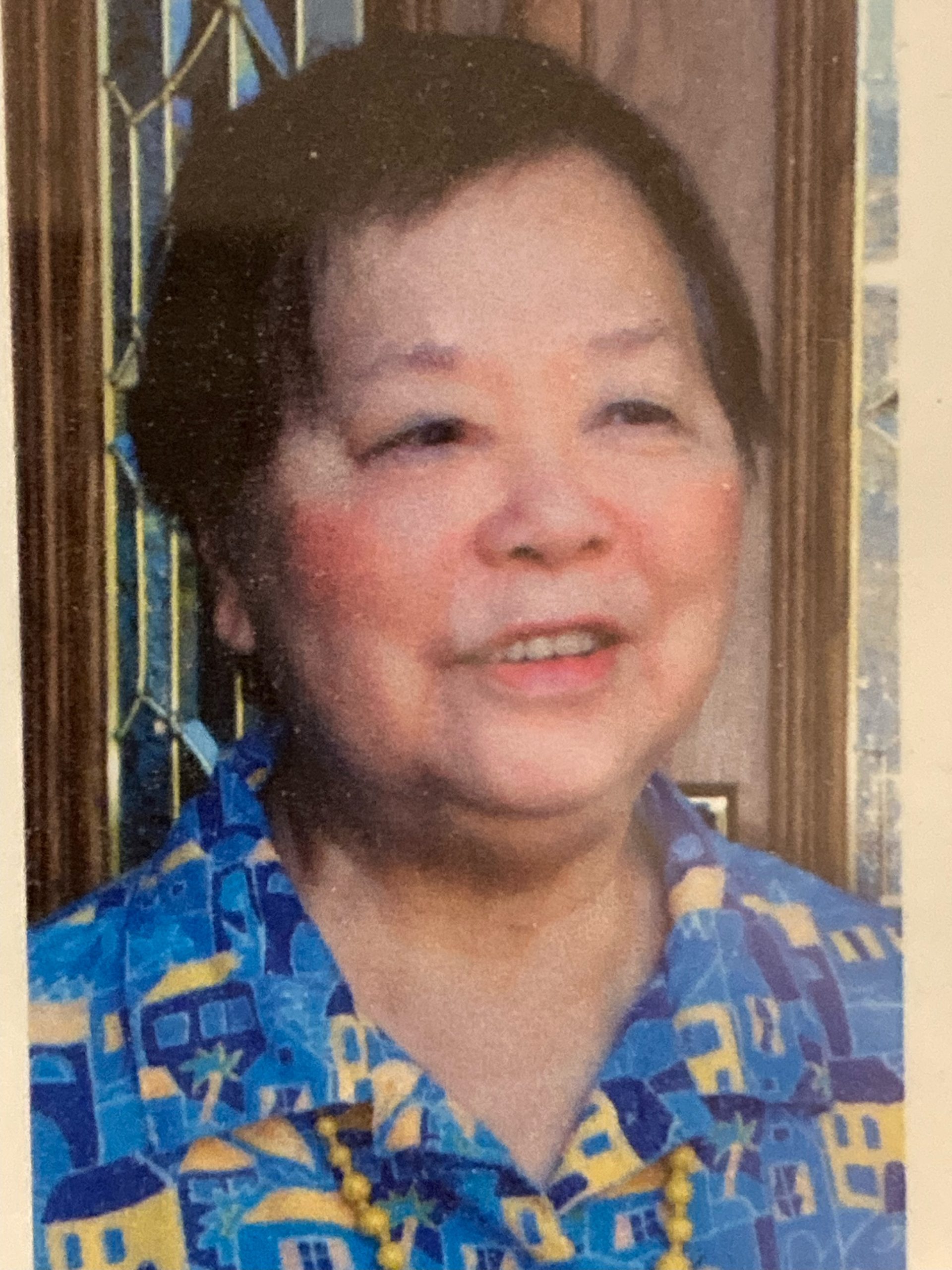
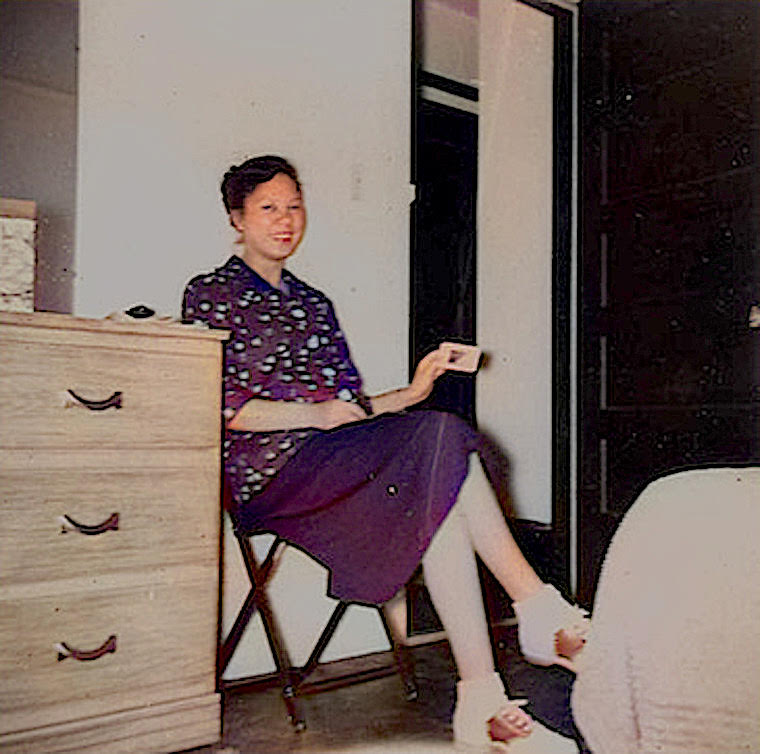
I first remembered our mom, when I was a baby alone in the crib, in our flat on Pacific Street.
I was crying for what seemed to be an eternity.
Mom entered the front door, tall, slender and beautiful, wearing a camel coat with a fox collar.
I had been left with a robust red-headed babysitter who would come now and then, then leave me alone to cry hopelessly.
Somehow, when I saw our beautiful mother, I knew she was my real mom.
As a baby, what I didn’t know, was our mom was a working mom, working in the Jung Chinese Laundry on Polk Street.
Dad was a Muni bus driver, and Richard and I shared a crib. Richard was my everything, unless he too was gone.
Marilyn was born, and took over the crib.
Richard and I shared the Murphy bed that came out of the closet.
Richard and I would go with mom, when we were walking tots, to help sort socks, and fold towels at the laundry. Grandpa taught us how to use the Abacus.
My grandparents were very fast using the Abacus to calculate the amounts to charge the customers.
Welcome to Polk Street
I remember Grandpa Jung towering over everyone, except Uncle John.
I remember Grandma Jung being only 4’ – 10” but as strong and able as anyone I knew. When she let down her hair, it went clear to the floor.
I remember clearly watching her walk down the hall upstairs from the bathroom to the bedrooms.
Grandma Jung called mom A-Thoo – which meant first born child in Toisan.
In the Chinese countryside, families had so many kids, that they would call them by birth order.
There was a large black & white photo of mom and Auntie Jean hanging in the dining room. I think they were young.
Mom was the first born child in Macon Georgia
Auntie Jean had often remarked that our mother was not smart, most likely because Grandma Jung was malnourished when she was pregnant with Mary.
Uncle John and Auntie Jean graduated from UC Berkeley. Uncle John went on to get his PhD from Northwestern. Auntie Jean got her masters in Teaching from UC Berkeley.
Some people think that Uncle John and Auntie Jean weren’t very smart either.
Macon was a harsh place. They were Macon smart. They went to school, then came home and worked in the family laundry.
They grew up as the only Chinese family in Macon, because of the US Chinese Exclusion Act (1882 to 1943) during the Jim Crow Laws (1865 to 1966)
The Jungs were extremely smart, to survive during these times, when if you ain’t White, and you ain’t Black, you Nothin’.
The Jungs were put in the White school, but the Whites wouldn’t be friends with them. Even as a teen, I was called a “chink” in school. I’ve been asked to dig an hole to China and go back to where I came from when I was at UCLA. Racism still runs rampant in the US where Chinese are targets of hate crimes. Imagine how many magnitudes worse it was for the Jung’s.
There was a white church behind their Chinese laundry at 333 Mulberry Street.
One thing that the Jungs didn’t believe in, it was going to church.
I observed over the years, that when topics about going to church would arise among them, they consistently leaned back and their eyes opened a tad wider.
They didn’t want to go to church.
I think the some whites from church behind them treated them horribly.
Richard and I went to the Chinese Presbyterian Church in San Francisco Chinatown. After we moved to East Palo Alto, I asked if we could go to church, since we spent some weekends in San Francisco. The answer was always No.
Racism was still rampant, as it is today against Chinese. At an early age, we American Born Chinese were taught to be humble, and say nothing, as a way to avoid danger.
For mom, and her family, living in San Francisco was a dream.
Grandma Jung used to have to order Chinese groceries from New York for $10 when they were in Macon. She said that a loaf of bread was 5 cents in Macon, so $10 was a very expensive bag of groceries.
Our mom worked all her life in Macon, then in San Francisco, before she married our dad. Work was a way of life for all Chinese Americans, young and old.
When we moved to East Palo Alto, for Dad’s job in Sunnyvale, this was the first time in Mom’s life that she didn’t have to work. She became a full time mother of 4 kids by the time Gigi was born.
East Palo Alto was a dangerous place. Having grown up in Macon, Mom was well equipped for the responsibilities.
Mom saved my life. For this I am forever grateful
Like Grandma Jung, our mom was very strong when she had to be. Mom saved my life in East Palo Alto, when I was pre-kindergarten age. For this, I am forever grateful.
One day, I was being strangled my Mr. Delbino, our Italian neighbor who only spoke Italian.
I couldn’t scream, but Mom’s sixth sense kicked in, and she came out into the yard, and screamed “Liz get inside the house right now!”
Mr. Delbino released his stranglehold on my neck.
She stayed outside with Mr. Delbino for a while. We didn’t talk about it ever. But she knew, and kept me inside. I never went outside without Richard, Mom or Dad again.
For a very long time, my neck hurt. I couldn’t swallow. I couldn’t take pills, and didn’t want to eat. To this day, I still have trouble swallowing.
The next week, my best friend Joanne Ancinnelli told me that her grandfather was in the hospital.
The next time I saw her, she said her Grandfather was dead.
What is Dead?
“What is Dead mean?” I asked. As a young child, I didn’t know what Dead meant.
“They put him in a box in a hole in the ground 6 feet under, then put dirt on top, so the dogs don’t eat him. Grandpa must have done something very very bad.” Joanne explained Heaven and Hell. Grandpa is far underground, so he was in Hell.
We went to her parent’s pile of LIFE magazines. We found one that had coffins for children in Ireland, due to the bombings and civil unrest between the Catholics and the Protestants.
Joanne’s family is Roman Catholic. Joanne said “This is what Dead is. They go to Heaven or Hell, and they turn back to 20 years old, if they died old.
East Palo Alto was a dangerous place
East Palo Alto was a dangerous place. It was nicknamed Nairobi, because it was 90 to 95% black, poor, welfare housing, etc. The elementary school aged boy across the street, stole a car, crashed it and died.
I’m looking at current maps. I think our house is at 2364 Cooley Avenue, East Palo Alto close to the bend in the road, near Weeks Street. Dad was renting it from Joanne Ancinnelli’s family. It still has 3 bedrooms and one bathroom, however when we lived there, Mom & Dad had a tiny bathroom to themselves in the Master suite. The outside was redwood, and inside had hardwood floors. the furnace was right outside Mom & Dad’s bedroom. I remember it making a big “boom” sound whenever it turned on.
Marilyn and Gigi shared the bunk beds in the corner back room next to Mom & Dad’s. Richard and I shared the bunk beds close to the dining room.
With 4 kids, when Dad was home, he helped take care of Richard and I, having us sort out resistors and capacitors. There were big smoky glass tubes, which I never touched. Richard helped with those.
On sunny weekends, Richard and I would help Dad work on the car. I remember Dad had this wide wooden board with swivel wheels that he would lay on to schooch himself under the car. Richard and I learned the name of all the tools, and handed them to Dad when he asked us for them.
Mom was in the house taking care of Marilyn and Gigi.
We walked to school in groups for safety. There was a town crazy man, who notoriously chased kids and did things to them. Joanne and I were on the swings at the playground, when he entered the gate. We high-tailed out of there as quick as we could.
There were fights on the playground at every recess, everyday at school. Bobo was the strongest, and always won. As Chinese, we were smaller, and the bullies left us alone. I remember the Principal giving Bobo a whooping.
The schools were poor. We shared Dick and Jane books. Nobody in our school looked like Dick or Jane. Well, there were a couple of white kids, like Joanne Ancinnelli. The schools could barely afford paper. We did our math on the chalkboards.
There were good times, and there were very bad times in East Palo Alto. We had a Loquat tree, raspberries, 2 plum trees, a walnut tree, an Apricot tree, a Peach tree and a Nectarine tree. We used to climb these trees and harvest the fruit, bringing them in the side kitchen door to Mom.
There was a big bull in the yard between our house and the bend in the road and the barber shop. Then they built a 2 story apartment house where the bull was. Unfortunately, the tenants started throwing things at our house. One evening, someone threw a molotov cocktail into our front yard. Dad called the fire department, who put it out. After that, Dad took us house hunting for a new place to live, not in East Palo Alto.
Hower Tong and Stanford
Dad needed the family car to go to work. Mom didn’t drive for the longest time. When she finally was able to drive, it opened up the opportunity for Mom to take us on field trips to Stanford University, where Hower Tong bicycled to school.
It was a Chinese American Tradition, out of necessity during the Chinese Exclusion Act, to take in Chinese into our homes to live with us. Hower Tong lived with us while attending Stanford University. I think Auntie Amy and Uncle Benny arranged this. I think having Hower in the house opened up Mom’s awareness of places to go in Palo Alto.
Mom took us to a huge park where there was a mausoleum for Leland Stanford Jr, and his parents. It was above ground. Mom told us that their son died young, and that his parents named this university after him.
Wow. The whole family mausoleum was above ground. The whole family were good people and went to Heaven. Everything was beautiful. There was a big angel statue (Angel of Grief). Visiting this site has been imprinted in me forever.
Mom took us to the Stanford Museum where the huge railroad spike is displayed. The University was peaceful and beautiful. Mom brought us here often. I decided that I wanted to go to university when I grew up.
Mom also would take us to Stanford Shopping Center. She had us hold hands, so that two of us were on one side of her, and the other two were on the other. We formed a long chain, with Mom in the middle. We were well behaved when we were here. Nobody let go of the chain.
Stanford Shopping Center was beautiful! The concrete pavement had sparkles in it, and wavy segments which wrapped around the raised planter boxes surrounded by sparkly concrete benches.
We were too poor to shop there, but it was refreshing to visit.
Palo Alto and Gumby
I don’t know where I got the idea that Palo Alto had a ravine around it, but we could certainly see it. Adobe Creek is on the East boundary, San Francisquito Creek is on it’s west boundary, and it has several creeks running through it.
I remember weeding the garden, and painting the snail shells with Tempera paint that we got from Auntie Jean. The soil was blacker than any natural soil I have seen in my life. University Avenue was the main street through downtown Palo Alto leading to Stanford. There were huge beautiful houses with enough land around them to have beautiful gardens. Mom said that the Stanford University professors lived there.
There were Saturday cartoons at the Stanford Theater at 221 University Ave. There was also a Savings & Loan which hosted Gumby animations for kids. This was the best part of the week!
Having a family car allowed us to be somewhere else. Dad took us on Sunday drives. One outing, we brought Wonderbread sandwiches for lunch. We found picnic tables in the park in Woodside. As we were playing, a boisterous Blue Jay grabbed Gigi’s sandwich and ate it. Mom made Gigi special butter sandwiches, which were really made with Blue Bonnet margarine. I guess Blue Jays don’t like mayonnaise that was on the rest of the bologna sandwiches.
Mom’s first car accident
Mom started driving when we were in East Palo Alto. Cars didn’t have head rests or seat belts back then. I remember we kids were all in the car when mom had her first car accident. it was on University Avenue east of downtown Palo Alto. I was on the floor in the front seat. an ambulance came ant took me away. I remember being is a pitch black room in a hospital, with 4 men with masks looking down at me. There was a ceiling light over me laying on a table. Everything else was black.
I don’t know what happened to everyone else. I do remember coming home from the hospital. One of my eyes was swollen shut, all black and blue like the rest of that side of my face. I looked horrible! I told Mom, that I didn’t want to go to school. It was almost the end of the school year, so she didn’t make me go to school.
Mom was a good mom with challenges
In light of the fact that she worked all her childhood life, she had no example of what a good stay at home mom was, except for television.
We watched “Father Knows Best”, “Leave it to Beaver”, “The Honeymooners”, “I Love Lucy”, “The Ed Sullivan Show”, “The Mickey Mouse Show” and cartoons.
I think most mothers at the time learned how to be good mothers from watching these TV shows. Kids learned to be good kids from these TV shows. In this era “children were to be seen, not heard” was not limited to Chinese American families.
Lucy and her friend Vivian on the “I Love Lucy” show was an example followed by American housewives, or how to be ditzy, defer to their husbands, and still have fun when it was just the two of them, especially cooking or doing housework as fun. They glamorized the role of the housewife, giving mom positive role models to follow.
Mom experimented with cooking American food. She made Pot Roast, Meatloaf, Chateaubriand, and of course Cantonese homestyle food.
Mom made us our school lunches everyday: bologna sandwiches and a fruit from our garden. She made Gigi butter sandwiches, which were really Imperial Margarine sandwiches, because Gigi didn’t like bologna. She used Wonderbread because it was popular at the time. It was fun to stick it to the roof of our mouths.
Mom, cooked, cleaned, took us places, and was very protective of us. Our job was to be Chinese American children, who are “seen not heard”. We did rather well, except Marilyn came home from the hospital crying all the time, and had rashes on the back sides of her knees and elbows.
We were from poverty, still in poverty. Going to the doctor was not what we did. Mom put calamine lotion on Marilyn’s rashes everyday. Marilyn was almost always cross. Marilyn was also very needy. She would hold onto me during recess at school. It was so annoying. One time I tried pulling away from her on the playground, and she ripped my dress! I think Marilyn had some undiagnosed condition. I have no idea if it was diagnosable at the time, or if nobody that mom took her to, could diagnose her. This made life difficult for our family. Marilyn and Mom spent so much time fighting that Auntie Phyllis called me the invisible child. Marilyn got all the attention, because she was so needy.
Chinese School at Palo Alto High School
Dad’s family spoke Cantonese, and Mom’s family spoke Toisan. For this reason we all spoke English at home. Mom and Dad took us to Chinese School one night a week to learn Cantonese. We learned calligraphy, kite making and other Chinese arts and crafts.
We would practice Cantonese only when we went to San Francisco on some weekends, to play with our cousins. At least we had some exposure to the language. Too bad Mom didn’t learn Cantonese also.